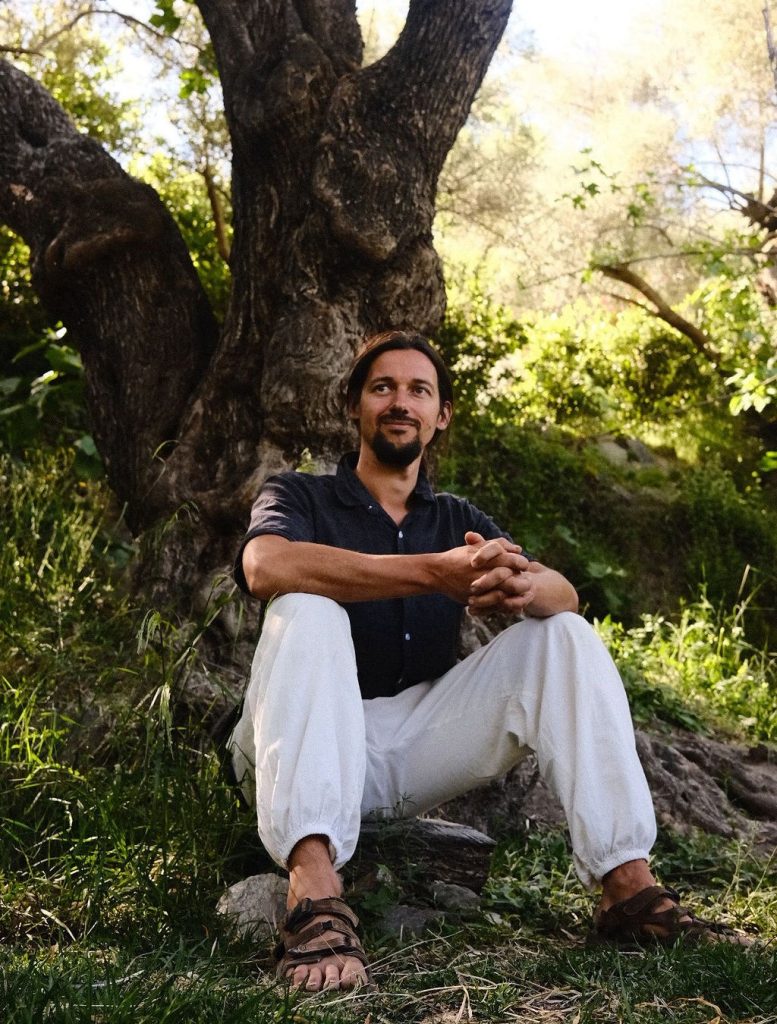
Floris Adriaenssens discovered yoga in Belgium in 2008, beginning a lifelong journey that has continued to shape and guide him. Together with his partner, Paulina, he spent more than a decade living in ashrams, communities, and yoga schools across Mexico, India, Spain, and France, completing multiple trainings along the way. He has since guided over 20 yoga teacher trainings, as well as numerous retreats and classes, drawing from classical Yoga, Tantra, the Bihar School of Yoga, and a rich blend of other traditions. Now based in Southern Spain, Floris and Paulina are the founders of Ananda Forest retreat centre—a sanctuary rooted in nature, community, and practice. When he is not teaching, Floris loves working the land and cherishes his role as father to Amba.
To learn more, visit www. amaratvayoga.com.


Introduction
Every human being longs for happiness. Yet the ways in which we seek it often differ greatly — through wealth, relationships, success, or spiritual practice. Paradoxically, the harder we chase happiness as an external goal and resist unhappiness, the further it seems to slip away. Yoga philosophy teaches that happiness is not something to acquire but it is the very nature of our being.
According to Patañjali’s Yoga Sūtras, happiness is realised when we transcend the fluctuations of the mind and recognise the Self. The obstacles to this recognition are called kleshas — afflictions that cloud perception and generate suffering. This article draws on the teachings of Patañjali’s Yoga Sūtras to examine the roots of happiness, the causes of suffering, and the methods he prescribes for liberation.
Patanjali’s Teaching on the Kleshas
Defining the Kleshas
In Yoga Sūtra 2.3, Patanjali identifies five primary causes of suffering:
- Ignorance (avidyā)
- Egoism (asmitā)
- Attachment (rāga)
- Aversion (dvesa)
- Clinging to life (abhiniveśah)
These afflictions shape our thoughts and behaviour, keeping us bound to cycles of craving, fear, and dissatisfaction. Patanjali emphasises that their root is ignorance (avidyā), which leads to a mistaken identification of the impermanent as permanent, the painful as pleasant, and the non-Self as the Self (2.5).
Ignorance as the Root
The pursuit of liberation from ignorance is often regarded as secondary to the pursuit of liberation from material poverty. Yet within yoga, ignorance is understood as the very ground from which suffering arises, obscuring the truth that all phenomena—sensations, objects, relationships, and even the body itself—are impermanent.
When pleasure arises, we may cling to it and resist awakening from illusion. Wealth, comfort, and success can seem to embody happiness, yet they remain impermanent.
Paradoxically, it is often pain that becomes the catalyst, urging us to see through the veil of appearances. What lies beyond these shifting experiences is the very source of awareness itself—a truth beautifully captured by Saint Francis of Assisi: “What we are looking for is what is looking.”
The Dance of Joy and Pain
Pain as Teacher
Pain is an inescapable part of human life; it is woven into the very fabric of our existence. In yoga, however, pain is not seen as an enemy but as a profound teacher—one that awakens clarity, insight, and discernment. Without moments of discomfort, we might never feel compelled to look beyond fleeting pleasures and examine what truly brings lasting fulfillment.
Yoga teaches that ignorance often leads us to mistake the painful for the pleasant. Indulging in rich food, for instance, may provide momentary delight, but it often leaves us burdened and regretful. Conversely, practices that seem challenging—such as fasting, cultivating self-discipline, or committing to regular āsana—can cultivate resilience, inner freedom, and enduring joy. Through this lens, even pain becomes a guide, pointing the way toward deeper awareness and authentic well-being.
The Impermanent Cycle J
oy turns into sorrow, sorrow into joy — like the seasons cycling endlessly. Recognising this impermanence helps us release attachment. True happiness is not found in chasing after transient pleasures but in identifying with the Seer — pure awareness — rather than the shifting objects of perception.
Ego and the Illusion of Identity
What is Egoism?
In Yoga Sūtra 2.6, Patanjali defines egoism as the identification of the Seer with the instruments of seeing. In simpler terms, the ego arises when we mistake the Self for the body, thoughts, and emotions.
The ego is not a tangible entity but a solidification of habitual thought patterns. When we identify with it, we suffer because we cling to what is impermanent. Just as we discard an old car when it no longer serves us, we must learn not to cling excessively to the body or the narratives of the mind.
This naturally leads to the topic of attachment. Acting from a personal perspective, we inevitably develop likes, dislikes,




and attachments. It is the nature of the mind to gravitate toward beauty and pleasure. Liberation from this tendency cannot, and probably should not be forced. Yet, when we shift our attention to the spaciousness of awareness—the field that holds everything unconditionally—we naturally align with the Essence of our being, which exists beyond the clinging of the ego.
Egoism and attachment cannot be eliminated by sheer effort, for the ego itself would resist. True release arises from surrender— surrendering to the spaciousness within and to the Source of Life itself.
From Ego to Attachment and Aversion
Ego gives rise to attachment to pleasure and aversion to pain. As Patanjali notes in Yoga Sūtra 2.15, for one who has cultivated true discernment, even joy carries an undercurrent of anxiety—because we instinctively worry about its eventual loss.
Take, for example, a deep attachment to Hatha yoga practice. When an injury or circumstance prevents us from practicing, that very attachment can become a source of suffering. Yet, by cultivating awareness of impermanence, we learn to engage fully with experiences without becoming bound to them. This allows us to enjoy life—and our practice—freely, appreciating each moment without clinging.
Fear of Death and the Root of All Fears
Clinging to life (abhiniveśah) is perhaps the most primal affliction. It stems from ignorance of our true nature. If we believe we are only the body and mind, death becomes terrifying. Yet awareness itself — the Seer — does not die. Just as a flower withers while another blossoms, life expresses itself eternally. Seeing ourselves as part of the eternal dance of life—as the ever-reincarnating Spirit and a manifestation of Cosmic energy—liberates us from the fear of death. This perspective invites us to recognize life as a continuous flow, where endings are simply transformations, and our true essence remains untouched and timeless.
Mapping Attachments Through the Chakras
While Patanjali does not explicitly mention the chakra system, later yogic traditions offer a valuable framework for understanding attachments. Connecting the chakras to psychological states blends ancient wisdom with more modern interpretations. Regardless of its origins, the chakra system provides a comprehensive and practical “psychological map,” integrating body, energy, and mind in a way that can illuminate patterns of attachment and growth.
- Mūlādhāra: attachment to safety and possessions.
- Svādhisthāna: craving for sensual or sexual pleasure.
- Manipūra: attachment to power, status, or control.
- Anāhata: clinging to love, relationships, or devotional bliss.
- Viśuddhi: attachment to artistic or visionary experiences.
- Ājñā: attachment to spiritual or intellectual power.
- Reflecting on these can help practitioners identify where attachments bind them and adapt their sādhanā accordingly.
Karma and the Cocoon of Suffering
Patanjali teaches in Sutra 2.12 that the womb of karma has its root in the kleshas. Karma unfolds in seen and unseen ways, perpetuating cycles of suffering. Swami Satchidananda illustrates this with the story of silkworms: by overindulging, they spin cocoons that entrap them. Liberation comes only when wings of discrimination (viveka) and dispassion (vairāgya) allow them to break free.
Methods to Overcome the Kleshas
Tapas (Discipline)
Tapas means “to burn” or “to shine”. It refers to disciplined practice that transforms energy — whether through āsana, prānāyāma, meditation, or ethical restraint. Even in daily life, resisting compulsive expressions of uncontrolled anger or choosing compassion over egoistic response is a form of tapas.
8.2 Svādhyāya (Self-Study)
Self-study involves both introspection and study of sacred texts. Listening to teachers, reflecting on scripture, and observing one’s own patterns are ways to cultivate wisdom. It is not about amassing information but deepening awareness.


Īśvara Pranidhāna (Surrender to the Divine)
Surrendering to the Divine means opening to the reality that consciousness itself is sacred. Devotion, prayer, and chanting help dissolve the ego’s grip, revealing the unity of all beings.
Meditation
In Sutra 2.11, Patanjali teaches that active mental patterns/vasanas that cause suffering, can be transformed through meditation. As thoughts slow, the gaps between them reveal the silent ground of awareness. This state of nirodhah (cessation) purifies the subconscious and aligns us with our true nature.
The Journey of Transformation
Overcoming the kleshas is neither instant nor linear. We may slip back into ignorance or attachment. Yet every moment of awareness strengthens the witness. The process is like a spiral — sometimes repeating, always deepening.
Ultimately, awakening transcends time. By unlearning conditioned patterns and resting in the Self, we taste a happiness that is uncaused, boundless, and permanent.
Conclusion
Patanjali’s analysis of the kleshas reveals that suffering arises not from life itself, but from ignorance and misidentification. Happiness is not found by clinging to pleasure or resisting pain, but by realising the Self as pure awareness — the eternal witness of all experience.
Pain, when embraced consciously, becomes a teacher. Discipline, self- study, surrender, and meditation are the tools Patanjali offers to cut through ignorance. In doing so, we gradually dissolve the cocoon of karma and awaken to the infinite joy of our true nature.
As St. Francis of Assisi beautifully prayed: “For it is in giving that we receive, it is in pardoning that we are pardoned, and it is in dying that we are born to eternal life.”