We Don’t Have to Try So Hard
I’m a recovering overdoer — in everything. As a doctor, as a meditator, and certainly as an Ashtangi.
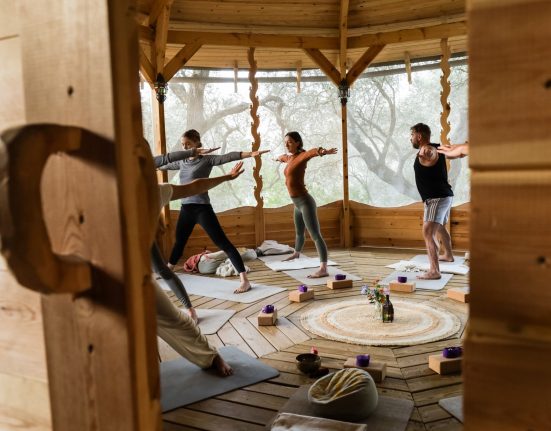
The moment everything changed for me was one dawn morning at the shala. The room was thick with ujjayi breath and quiet discipline. My teacher, Casey, was moving silently through the room, offering subtle adjustments. I was deep in utthita parsvakonasana — side angle pose — working hard to press deeper, to open, to do it right.
The moment everything changed for me was one dawn morning at the shala. The room was thick with ujjayi breath and quiet discipline. My teacher, Casey, was moving silently through the room, offering subtle adjustments. I was deep in utthita parsvakonasana — side angle pose — working hard to press deeper, to open, to do it right.
I — and probably many of you — often work far too hard. It’s because we love life and want to live it fully. Yet, paradoxically, it’s this very effort that often holds us back.
Today we’re going to explore a deeper understanding of “stretching” through the lens of the nervous system — so that you and I both can deprogramme effort and find greater depth and ease in our bodies and in our lives.

The Misunderstanding of
“Stretching”
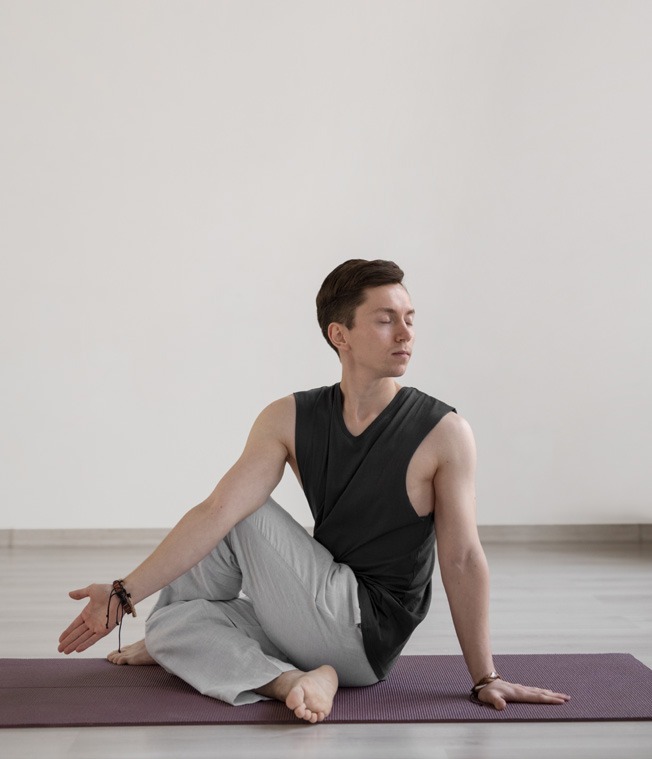
If I were to put your nervous system to sleep with an anaesthetic, you would instantly have full range of motion — full splits and perfect pigeon — no more “tight” hamstrings. Medical doctors use this principle to rehabilitate joints through manipulation under anaesthesia.
So What’s going on here? I thought you were tight?
We use the word stretching so casually — in yoga, in fitness, in daily life. Yet it’s a misleading misnomer.
Your muscles don’t get longer when you stretch. You already have all the length you ever will. The only reason you can’t get into the splits right now is because your nervous system doesn’t feel safe there — it’s holding a passive tone that limits your range of motion so that you can stay stable and secure. This is a good thing, because otherwise we’d be like the Straw Man from The Wizard of Oz.
When we imagine stretching, we picture lengthening tissue through will or force — as though we could pull ourselves into openness. But our muscles are not elastic bands to be stretched; they are sensory organs, listening constantly for cues of safety or threat.
Flexibility, therefore, isn’t about how far we can push. It’s about how safe our nervous system feels. Until the yoga and fitness world truly understands this, our path into easeful openness will remain full of resistance.
It’s About the Nervous System
Your nervous system is the operating


system of the body. When it’s in a state of stress, it will be tight and protective— in your body, your mind, and your life. When it feels safe, it allows for creativity, healing, and depth — again, in your body, your mind, and your life. This operates at the muscular level through receptors called muscle spindles. When they detect that a muscle is being lengthened too far or too fast, they send a signal to contract in defence. Your body is smart; it wants to protect you.
The harder we pull, the more these spindles resist. And when we push past that resistance with effort, we reinforce the very pattern of tension we’re trying to release.
That’s why so many of us, even after years of “stretching,” find ourselves bumping up against the same limitations. What we’re meeting isn’t a muscular barrier — it’s a neurological one.
Steadiness and Ease: How the Nervous System Opens
Did you know what Patanjali said about effort in your asana practice? Nothing. Nada.
In the Yoga Sutras, he writes: sukham sthiram asanam — “the posture should
be steady and easeful,” From a nervous system perspective (not to mention an energetic and spiritual one), he was absolutely correct.
That’s because when we shift from effort to breath, something profound happens. the brain receives the signal: we’re safe now . Full, long, unlaboured breathing is the quickest way to bring your nervous system into safety.
In this calmer state, another set of receptors — the Golgi tendon organs — begin to activate. Their job is to sense tension and, when appropriate, to allow the muscle to release.
That “melting ” you sometimes feel in a posture dosen’t come from pushing harder — it comes form entering safety. The nervous system decides it no longer need to protect you.
Balancing Your Nervous System
This is probably no surprise to you, but most of us in the modern Western world experience far more stress than is healthy. We spend roughly 80% of
our time in stress and only dip into periods of ease and calm — when it really should be the other way around. When ou nervous system is in a chronic state of stress, we can’t heal, connect or create. Our yoga practice helps to balance this.
Hatha yoga — the physical postures of yoga — is designed to balance, tone, and strengthen the body and mind for health, and to prepare them for deeper States of medication. Traditional hatha yoga looks very different from the highly aerobic and gymnastic classes commonly practiced in the West(no to make that wrong — I love it).
But when your yoga practice reinforces the go ,go,go of our normal lives instead of balancing it, we have a problem. Bringing that same striving energy onto our mats perpetuates the imbalance in our nervous systems and hols us back from deepening our postures.
our yoga practice, then, becomes a study in discernment. When am i activating in service of alignment and stability, and when am i efforting from old habits of striving?
Flexibility comes not from pushing but from feeling safe. When breath is steady and easeful, the nervous system opens naturally. You don’t need to try so hard to expand.”

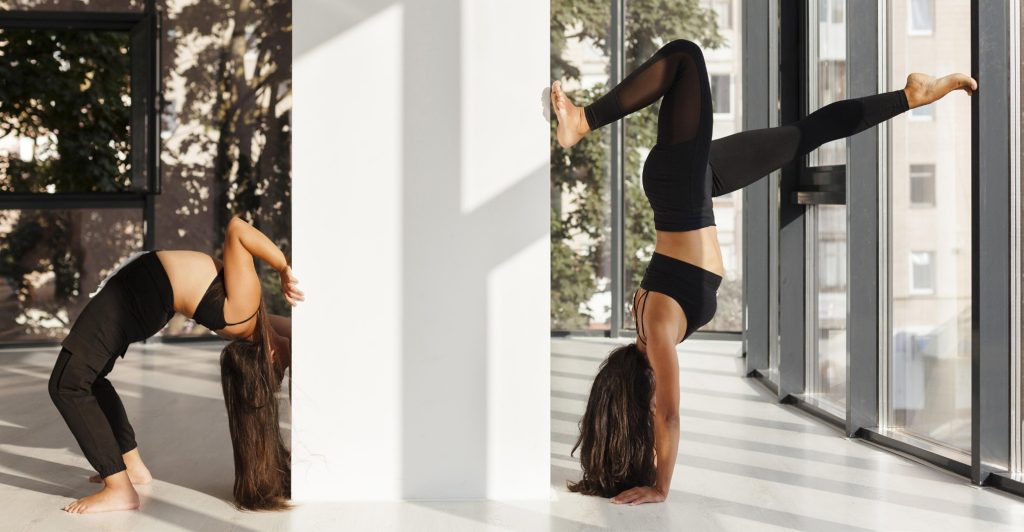


In the shala, my real practice now is to recognise the subtle moment when I shift out of ease into striving. That’s when I remember the simple mantra: You don’t have to try so hard.
Breath: The Bridge between Effort and Ease
So if stretching isn’t about effort but rather about tuning our nervous system, what are the implications for our yoga practice?
Great question. And the answer is built right into the practice, hiding in plain sight. We just forget it because it’s so subtle — so obvious. It’s the breath.
Pattabhi Jois, the creator of Ashtanga Yoga, described practice as “a breath meditation with movement.” That’s because the breath is the key link into the nervous system and the path to the deeper layers of yoga.
We only go as far, as deep, or as long as we maintain connection with the breath. That doesn’t mean we don’t breathe hard, or that the breath is always the same — for example, it will naturally shorten in a deep twist. But when the breath becomes ragged,
panting, or strained — when we’re making faces that look like effort — it’s time to set the contortion aside and return to doing yoga.
When you practise this consistently, a fascinating thing starts to happen: the muscles and fascia begin to respond. The fascia — the connective tissue network that wraps and weaves through every muscle — has its own contractile component. It hydrates, slides, and reorganises.

What we experience as “lengthening” is not tissue being stretched like rubber, but a re-patterning of this neuro-myo-fascial web.
This is why the most advanced practitioners often seem to move effortlessly, as though their bodies have become liquid. It’s not from effort — it’s from breath.
From Force to Dialogue
When we reframe flexibility as a conversation rather than a conquest, everything changes.
Your nervous system relaxes with breath — and also when it’s able to take in more sensory information. So rather than forcing a pose, your goal can be to feel a pose. Doing this tones the nervous system for safety and gives you the ease and stability that Patanjali was speaking of. Each posture becomes a dialogue:
Is my breath ragged or panting?
Am I making a strained face, or can I relax?
Am I trying to get somewhere, or am I trying to feel?
This approach honours the wisdom within the system. The body is not an object to be manipulated; it is a living field of intelligence. When we meet it with respect, it responds with trust — and trust is what allows true opening.
Beyond the Mat: Effort as a Habit of Being
How we move on the mat is not separate from how we move through life. If we habitually approach our practice through striving, achievement, and comparison, those same nervous system patterns shape how we work, relate, and heal.
Learning to soften in asana teaches us to soften in conversation, in decision-making, and in the face of uncertainty. The breath becomes our teacher — a constant reminder that expansion arises not from force, but from surrender.
The Ancient Truth Remembered
What the nervous system teaches us, yogic philosophy has known all along. Sthira sukham asanam — the posture should be steady and easeful. Not steady then easeful, but both at once. The balance of structure and surrender is the living art of yoga.
The modern impulse to stretch reflects a deeper cultural story — one that equates transformation with effort, and effort with worth.Shifting the focus from force to feeling changes everything. To stretch is to assume we must change ourselves.
To breathe is to remember we are already designed to open.
And sometimes, all it takes to remember that truth is a quiet voice beside you saying, “You don’t have to try so hard.”Shifting the focus from force to feeling changes everything. To stretch is to assume we must change ourselves.
To breathe is to remember we are already designed to open.
And sometimes, all it takes to remember that truth is a quiet voice beside you saying, “You don’t have to try so hard.”



Dr Kent Drever, DC is a chiropractor and nervous system specialist seeing patients in person in Portland, OR, and remotely around the world. His work bridges chiropractic philosophy, trauma release, and somatic practices to guide people to heal from the inside out.
Follow him on Instagram @doctordrever or visit www.drkentdrever.com
Words: Dr Kent Drever, DC