PRANAYAMA IS A PROCESS IN THE PRANIC, NOT THE PHYSICAL BODY
Words: Angela Andrea Ashwin
“Life is said to exist only so long as there is vayu in the body. Its departure is death.”
What is Prana?
Prana (life) ayama (expansion) is a practice, listed as the fourth limb in the Patanjali Yoga Sutras and is a major focus in Hatha Yoga.
When yoga came to the West, prana was incorrectly translated with the English term “breath,” and pranayama as “breathing practice.” This is when pranayama got lost in translation.
Prana is neither breath nor energy. It is “life,” which circulates within us and all other living creatures on this planet. Prana moves like wind (vayu) within living bodies, and when it departs, death occurs. “…constant motion (vayu) commences as soon as we are conceived in our mother’s womb.”[1]
It makes us evolve and grow, then it retreats and death occurs: “Life is said to exist only so long as there is vayu in the body. Its departure is death.”[2]
What is life? It cannot be seen, it cannot be touched, it cannot be thought—but it unquestionably is. The West only acknowledges the existence of realities that can be seen, touched, and thought, so life is not a reality the West reflects on. However, the Yogis did.
Four Vayus (Winds)
Most Indian traditions speak about f ive vayus – the ways prana moves within the pranamaya kosha. Four of the vayus move in the rhythm of the breath, which is why vayu became wrongly identified with breath. Vayu and respiration share the same rhythm but are substantially different. Vayu expands from the navel centre outwards through the pranic body at the same time inhalation occurs; then vayu reverses back to the navel centre at the same time exhalation occurs.
I like to use the analogy of an orchestra to describe the breath-vayu relationship: rhythm is given by the conductor. Along this rhythm, both the violins (respiration) and the clarinets (vayu) are played. Although substantially different, these are linked by the waving arms of the conductor, creating harmony.
The Pancha Koshas (Five Sheaths)
The Indian Yogis experienced not one but five bodily layers. The West researches only the physical, anatomical body—that which can be seen and touched—but there is more in this universe than what our outer senses perceive. The Indian Yogis recognised the physical body, annamaya kosha, but were not particularly interested in it. That which upholds our physical appearance is the life-force within, prana, circulating in conductors called nadis, forming whirling centres called chakras, and creating a subtle, invisible reality, pranamaya kosha. Further layers are the mind (manomaya kosha), a space where thought takes place; inert knowledge (vijnanamaya kosha); and finally, at the core of our bodily system, the experience of bliss (anandamaya kosha).
The practice of pranayama influences the pranamaya kosha or pranic body, not the physical.
Pranamaya Kosha (The Second Bodily Layer, the Pranic Body)
Prana enters a forming foetus, settles behind the navel, forms manipura chakra (the navel centre), from where it expands, creating nadis and chakras, forming the whole pranic sheath, and remains until death.
Practical
Practice for a couple of minutes what is commonly known as diaphragmatic breath: inhalation brings air into the body, the diaphragm contracts, and the abdomen is squashed. Exhalation expels air, starting strong and getting weaker, like opening a balloon. This movement takes place between the nostrils and the diaphragm.
Then settle your awareness in the mid-abdomen. What do you actually feel? Something expands outwards during inhalation without squashing, followed by a drawing inwards during exhalation. The drawing back becomes stronger as it proceeds, not weaker. The movement originates in the mid abdomen, spreads in all directions, and then reverses.
Now practise kapalabhati for a few rounds (unblocks vayu), then focus on the movement from the navel centre.
Pranayama is the process of ensuring the free circulation of prana from the navel centre throughout the pranamaya kosha. It is a purely internal process. Prana does not need to be replenished.
Pranayama is not about supplying us more prana, but unblocking the pranamaya kosha. The fluctuating movement of prana from the navel centre outwards and backwards is called vayu.


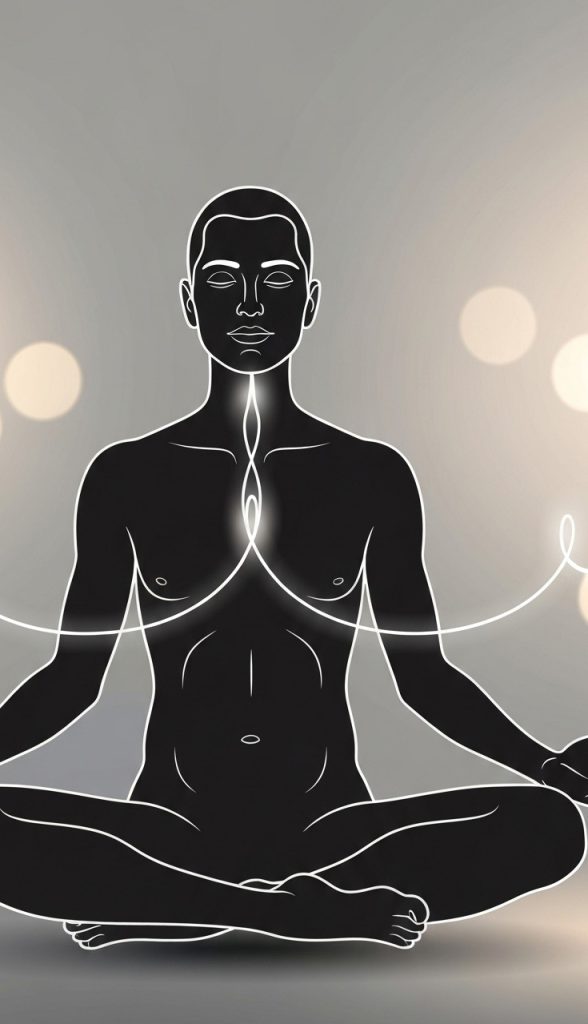
Try not to influence it. Sense the subtle movement in the mid-abdominal area. It may expand out far and fully reverse back. Return to respiration. Focus on the air through the nostrils, into the lungs, and out. Become aware that there are two very different processes.
Recognise that vayu and airflow move in opposite directions. Air flows inwards as vayu expands outwards, and when air flows outwards, vayu moves inwards.
Prana Moving in Pranamaya Kosha Comes in Six Forms
Four vayus move in the rhythm of the breath: apana (from the navel centre downwards), prana (upwards), samana (sideways), and udana (expansion into more remote areas of pranamaya kosha). The other two forms of prana are independent of breath: vyana (the fifth vayu) moves on its own throughout the pranic body wherever no obstructions prevent it. Vyana is like sunlight shining freely into all areas, except those that are shaded.
Practical
Practise a lying asana sequence on the right side only: stretch the leg up; lower it to the side; bend the knee and bring it toward the floor; bring the heel to the chest; jathara pravritti (lying twist).
Lie in savasana and sense the difference between right and left sides. The right side feels more alive, less solid, as if its matter form dissolves—a subtle element seeping through space. This is vyana.
With asana practice, you have removed some of the “shades,” and vyana expands more freely. Now practise on the left.

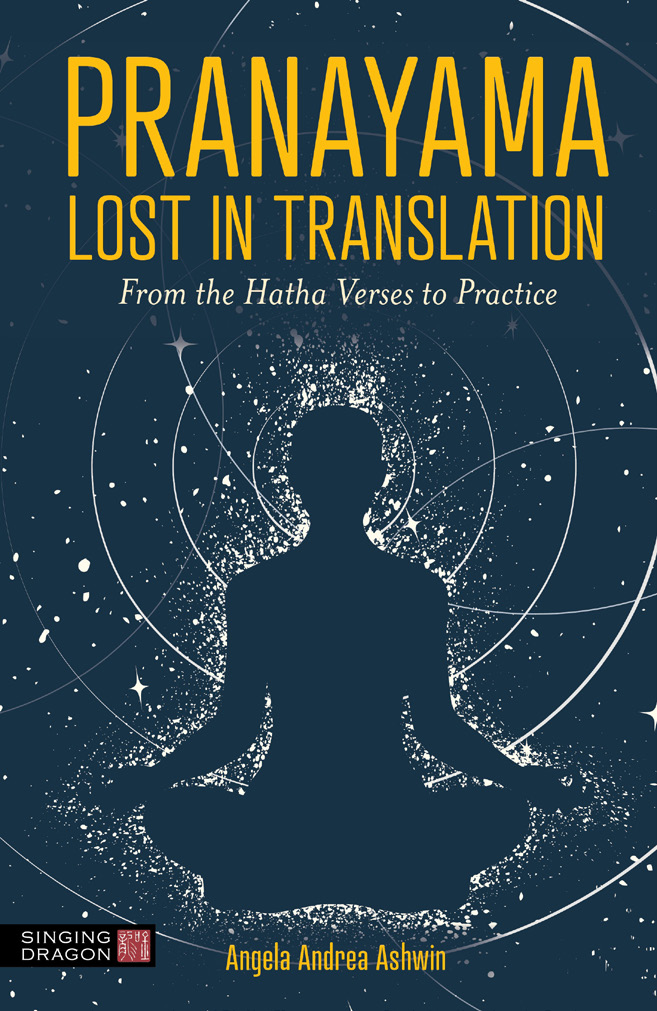
Adapted from ‘Pranayama: Lost in Translation: From the Hatha Verses to Practice’ by Angela Andrea Ashwin.
The book is available at: UK – https://uk.singingdragon. com/products/pranayama-lost-in translation US – https://us.singingdragon. com/products/pranayama-lost-in translation

References:
1. Swami Niranjananda Saraswati: Prana Pranayama Prana Vidya, Bihar, India, 2002, p. 580
2. Hatha Yoga Pradipika 2.3 (Sanskrit text, author’s translation)
3. Hatha Yoga Pradipika 2.4
4. Hatha Yoga Pradipika 2
5. Hatha Yoga Pradipika 2.71
6. The Yoga Sutras of Patanjali 2.50 (Sanskrit text, author’s translation)
Kundalini (the sixth form of prana) is the only form not residing in the navel centre, but in mooladhara chakra (the root chakra). It sits at the entrance of sushumna, the innermost spiritual nadi. Kundalini is dormant, but when vayu flow becomes free through pranayama, a stillness (kumbhaka) occurs. That powerful state awakens kundalini, which rises up sushumna, stilling the mind.
The Vayu Movement Purifies Pranamaya Kosha
“Malakulasu nadisu maruto naiva madhyagah/ Katham svad unmanibhavah karyuasiddhih katham bhavet//” 32 33 facebook.com/official.yogamag “When malakulasa (clinging obstacles) are in the nadis, marut (synonym for vayu) is not in the middle (sushumna). How can there be unmani (still mind)? How can siddhis (special powers) be gained?” [3]
There are obstacles (malas) situated in the pranamaya kosha. Their nature is clinging (kulasa); they block the nadi system and prevent the expansion of prana. Malas are created by our tendency to cling, to hold on, to not allow. We can feel them in asana practice when we meet resistance— when something holds. We call that muscle tension. Yes, the muscles are tense, but why? Underlying it is the tendency to cling: the malakulasa.
They prevent prana from fully expanding, reversing, and entering sushumna. When the malas are removed and the pranamaya kosha is purified, the heightened state of a still mind, unmani, occurs.
“Pranayamam tatah kurya nityamsattvikaya dhiya/ Atha sushumnadistha malah shuddhim prayanti cha//”
“Do pranayama always with a sattvic (illuminated) mind so that the malas (impurities) in sushumna nadis attain purity.”[4]
This verse defines pranayama as the method to purify the pranic body. The vayus move until purification is achieved; then they stop, and a new phase begins.
Pranayama Has Three Phases
Pranayama is not a series of practices as described in the Hatha texts (called kumbhakas), which only facilitate pranayama. Pranayama is not doing, but undoing obstacles so that aliveness can move freely.
“Pranayamasttidha prokto rechapurakakumbhakaih/ Sahitah kevalashchoti kumbhako dvividho matah//”
“Pranayama is said to have three elements: rechaka (expand out), puraka (fill in), and kumbhaka (pause after exhalation).”[5]
This verse reveals two important facts:
a) Rechaka is not exhalation but the expanding out of the vayu, which happens during inhalation. Puraka is not inhalation but the filling in of the vayu – the reverse back to the navel centre, which happens during exhalation. Most of us have learned that there are four phases of breath:
*Puraka: would be inhalation as something is filling in, not air but Prana; it actually occurs during exhalation as vayu reverses.
*Antara Kumbhaka: a pause after inhalation; no Sanskrit text mentions this and experienced Yoga practitioners know that holding breath after inhalation is forceful.
*Rechaka: would be exhalation, something is moving outwards, not air but Prana; it actually is the outward expansion of vayu during inhalation.
*Bahir Kumbhaka: pause after the exhalation, and yes it is.
b) There is only one kumbhaka, which follows the reversal of vayu, after exhalation. In that phase, kundalini awakens and sushumna becomes alive. The Hatha Yoga Pradipika speaks of two kinds of kumbhaka (2.71):
*Sahita Kumbhaka (incomplete): stillness followed by the expanding of vayu (inhalation)
*Kevala Kumbhaka (only kumbhaka): remaining in stillness, breath ceases Patanjali defined pranayama 1500 years earlier in the same way:
“Bahya abyantara sthambha vrtti desha kala samkhyabhih paridhrshto dirghasuksham.”
“Outward, inward, and suspended are the movements to be learned in the right place, time, and number. They are long or short.” [6]
There are three phases, not four. This verse agrees with the Hatha Yoga Pradipika, using different terms. Bahir (outward) is the expanding of the vayu, antara (inward) is the reversing of vayu, then comes one pause.
Nowhere in Sanskrit literature are the terms bahir and antara connected with kumbhaka.There is no such thing as antara kumbhaka.
Angela Andrea Ashwin is a yoga scholar, teacher, teacher trainer, practitioner, and author. She is a Diploma Course Tutor for the British Wheel of Yoga (BWY) and is known as an expert in interpretation and teaching of the original and authentic Yoga message. She holds a degree in Theology which gave her the skill of ancient text analysis. She studied Buddhist meditation, holds a GCSE in Sanskrit and engages in further Sanskrit language and literature learning. She owns the Gift of India Yoga School, and lives in Devon.
Want more information about the book, workshops etc?
info@angela-ashwin.co.uk www.angela-ashwin.co.uk https://www.instagram.com/ gift.of.india.yoga.school/ https://www.facebook.com/ angela.ashwin.7 https://www.facebook.com/ GiftofIndiaYogaSchool/